What Animal Is Only Found On The Galapagos Islands?
The animals that exist nowhere on Earth but the Galapagos, which islands they are actually restricted to, and which package routes reach them.
 By Oleg Galeev, Editor
What Animal Is Only Found On The Galapagos Islands?
The animals found only in the Galapagos are the marine iguana, the Galapagos giant tortoise, the flightless cormorant, the Galapagos penguin, the pink iguana, the Galapagos fur seal, and the waved albatross, which breeds almost exclusively on Española. UNESCO counts 36 reptile species here, every one endemic, and 18.2 percent of the 2,909 identified marine species live nowhere else, though several of these animals stay restricted to a single island, so your route decides what you see.
That last point is the one most lists skip. The Galapagos are not a single zoo where every famous animal waits on every beach. The pink iguana lives around one volcano on Isabela. The waved albatross nests almost entirely on Española. The Galapagos penguin concentrates around Fernandina and western Isabela, where the Cromwell Current pushes cold, food-rich water to the surface. A central-islands hopping package and a western cruise deliver two completely different animal lists, and both are legitimate Galapagos trips.
The scale of endemism is what makes the question worth asking properly. The archipelago sits about 1,000 km from the South American continent, far enough that arriving species were isolated for millions of years and evolved into forms that exist nowhere else. Around 500 native vascular plant species grow here, roughly 180 of them endemic. Twelve native land mammal species exist, 11 of them endemic, and 10 of those are threatened or extinct. Every reptile is endemic. Of the 2,909 marine species identified in the reserve, 18.2 percent are found only here. The Galapagos Marine Reserve itself, 133,000 square kilometres, is one of the largest in the world, so the endemism is not a small pocket, it is an entire system.
This matters for planning because the park protects 97 percent of the emerged land, and tourist activity happens only at 176 authorised visitor sites, 91 marine and 85 terrestrial, each with a defined set of permitted activities. You cannot wander off-trail to find an animal. You go where the site network goes, with a licensed naturalist guide, which is compulsory under the visit rules in force since Resolución MAE-PNG/DIR-2026-0044-RM. The practical question is therefore not just which animals are endemic, but which package puts you on the right island on the right day.
If wildlife is the reason you are booking, the packages below are the ones our roster carries that are built around exactly this: a short land-based wildlife trip, a full-board wildlife itinerary, and a seven-day cruise that reaches the western islands where the rarest species concentrate.
The Reptiles: Marine Iguanas, Giant Tortoises And The Pink Iguana
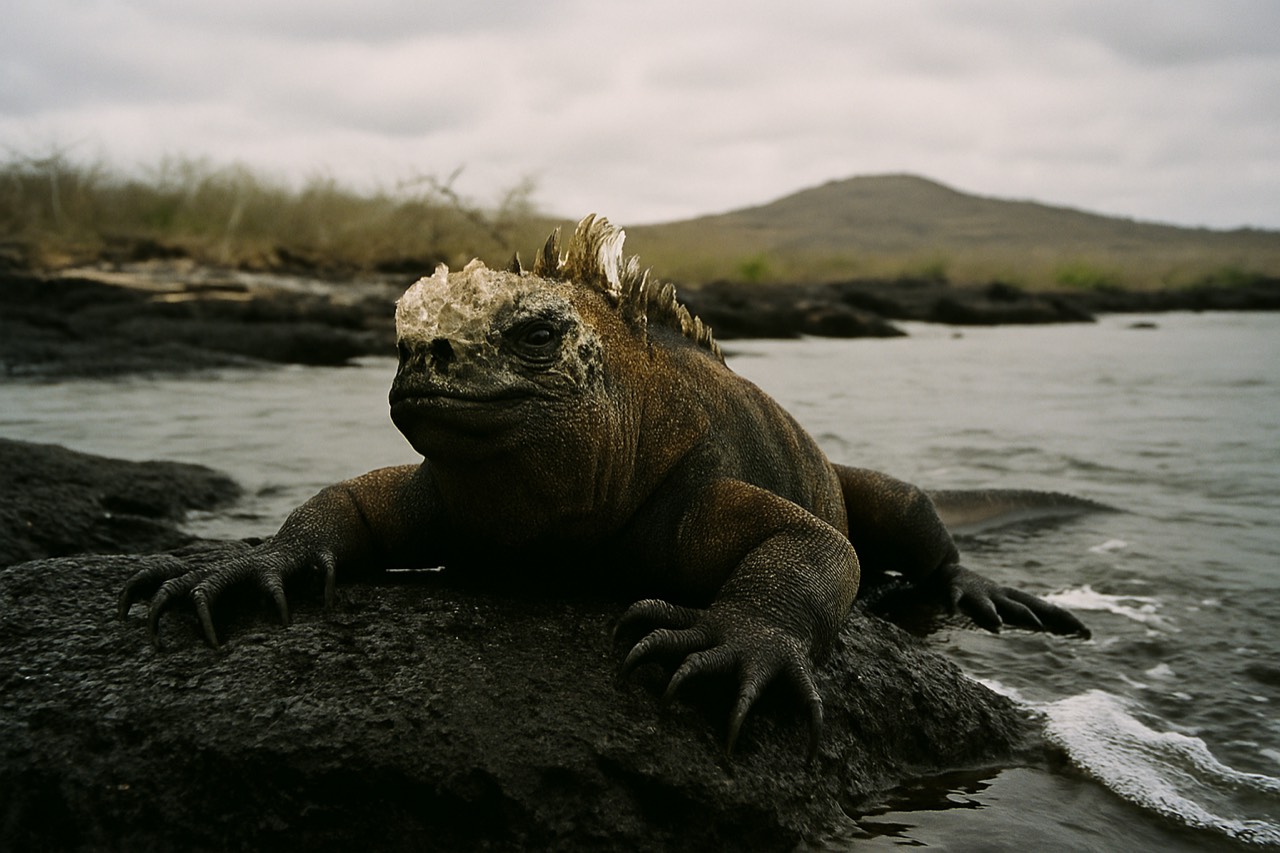
The marine iguana is the world's only lizard that feeds in the sea, and it is found nowhere but the Galapagos. The giant tortoise is the archipelago's icon, with an estimated 60,000 animals across distinct island lineages, and the pink iguana survives only on the slopes of Wolf Volcano on Isabela. All 36 reptile species in the islands are endemic, a complete sweep that no other large archipelago matches.
The marine iguana is the animal to explain to people back home, because it is genuinely unlike anything else. It dives to graze algae off rocks, sneezes excess salt from glands above its eyes, and clusters in the hundreds on sun-warmed stone to recover from cold water. There is no other marine lizard on the planet. The species counts in the 2025 monitoring report give a sense of how visible they are: 26,336 marine iguanas were monitored across the archipelago in that year, alongside 6,936 sea lions. You will see marine iguanas on nearly every itinerary, because they haul out on the coasts of most islands.
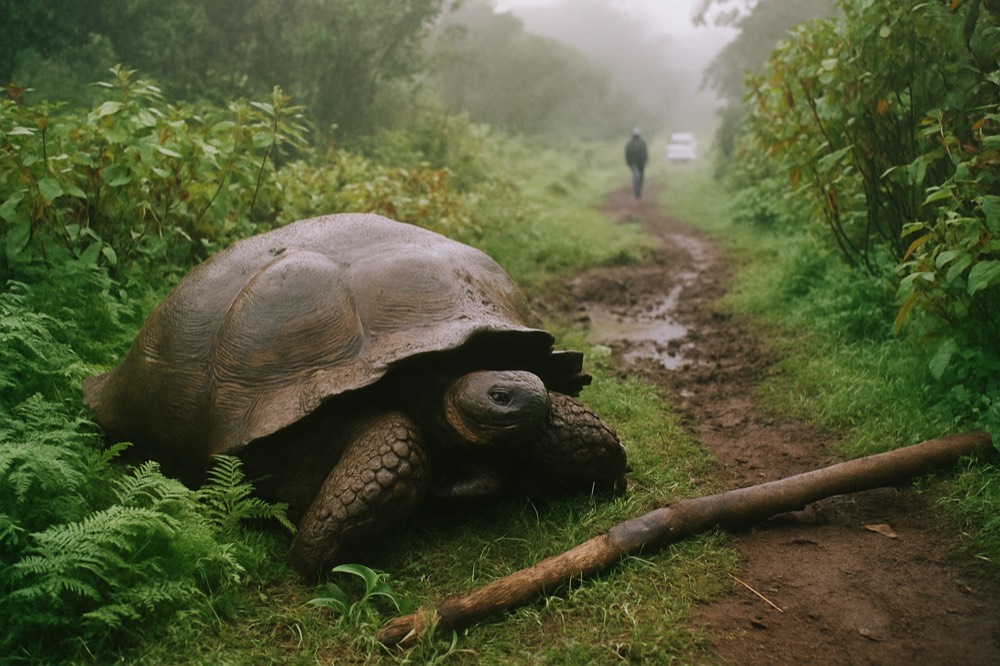
Giant tortoises are the headline endemic, and the story has a genuinely recent chapter. On 20 February 2026, 158 juvenile tortoises of Floreana lineage were released onto Floreana Island, the first time the lineage has walked there in over 180 years, the result of selective breeding from Wolf Volcano ancestry under the Floreana Ecological Restoration Project. The Charles Darwin Foundation, which announced the release, called it the first reintroduction of the project. Earlier, on 2 April 2025, 170 juvenile tortoises were repatriated to southern Isabela from the Arnaldo Tupiza breeding centre. The park estimates around 60,000 giant tortoises across the archipelago, and the Alcedo Volcano population on Isabela is considered the healthiest, estimated at 12,000 to 15,000 animals.
The pink iguana is the one that punishes casual itineraries. It lives around Wolf Volcano on northern Isabela, and it was only formally recognised as a distinct species long after the famous animals had all been catalogued, which is remarkable for a large, pink reptile. No standard tourist route visits its habitat, so if a seller promises you a pink iguana on a central-islands trip, that promise is wrong. Land iguanas are more accessible and have their own comeback story: between August and October 2025, 1,500 land iguanas were reintroduced to Santiago Island from North Seymour, a species absent from Santiago for well over a century, building on earlier releases that totalled more than 4,000 animals.
One booking mechanic now directly affects the tortoise sites. Under the 2026 visit rules, the Fausto Llerena breeding centre on Santa Cruz, the Arnaldo Tupiza centre on Isabela and the David Rodríguez centre on San Cristóbal all require an advance reservation through the park's system, issued as a single QR code tied to one group, one guide, one date and one time slot. Only agencies registered in Galapagos province can make those reservations. In practice this means the breeding centres can no longer be walked into on the day through an unregistered operator, so booking through a properly registered package matters more than it used to.
If you want the tortoise and iguana story in a short trip, the four-day land options based around Santa Cruz are the most direct route. You can also Check availability on the wildlife adventure package that covers San Cristobal, Santa Cruz, Isabela and Santa Fe with hotel pickup.
The Birds: Flightless Cormorant, Galapagos Penguin And The Waved Albatross
The flightless cormorant is the only cormorant on Earth that lost the ability to fly, and it lives only around Fernandina and Isabela. The Galapagos penguin is the only penguin that lives and nests on the equator, roughly 35 cm tall, and the waved albatross breeds almost exclusively on Española. All three are on the IUCN Red List as threatened, and all three are route-dependent: miss the western islands or Española and you miss the bird.
The flightless cormorant is evolution at its most literal. With no land predators on the isolated western shores, wings became surplus, and the bird instead became a superb underwater diver. The census numbers tell you how small the population is: a joint expedition by the national park and the Charles Darwin Foundation counted 762 flightless cormorants in 2024, and the 2025 monitoring counted 656. Those are not populations you can rely on bumping into by accident. They concentrate around Fernandina and the western coast of Isabela, which is exactly why western cruise itineraries exist.
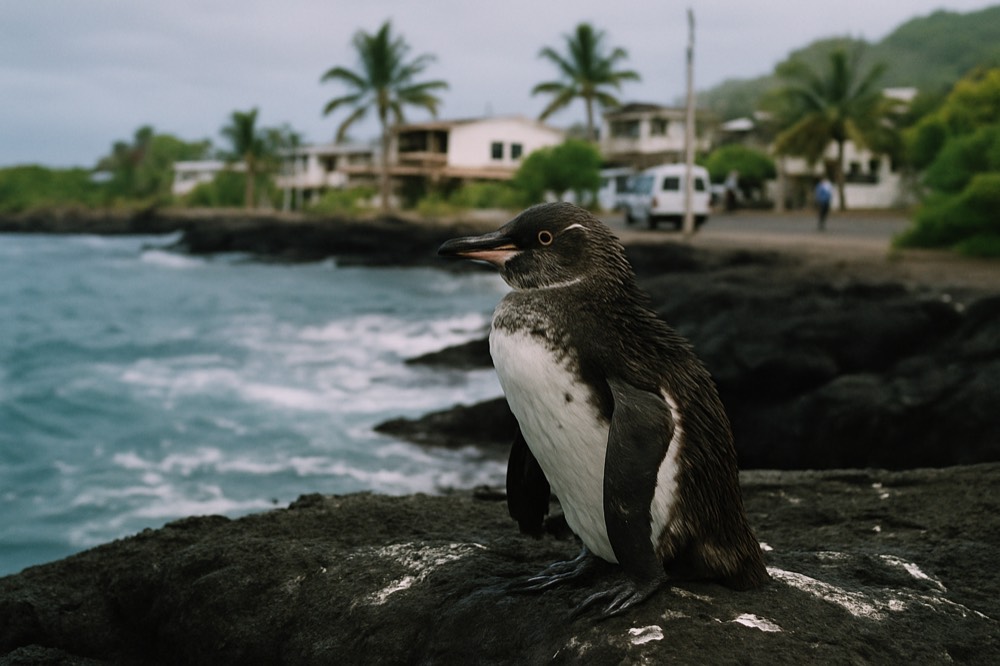
The Galapagos penguin has the best fact on the islands: it is the only penguin species that lives and nests on the equator, and one of the smallest in the world at about 35 cm tall. Its breeding does not follow a calendar, it follows sea temperature. Peer-reviewed work by Boersma found the penguins are significantly more likely to breed when water sits at or below 22 C, because the cold upwelling around Fernandina and Isabela, driven by the Cromwell Current, brings the fish. The 2024 census counted 413 penguins, with 96 percent adults and only 1 percent juveniles, which the park attributed to poor breeding probably caused by food scarcity. The 2025 count was 391. Any source that hands you a tidy "penguin breeding season" of named months is inventing it.
The waved albatross is the island-restriction case in its purest form. Adults arrive at Española from March, eggs are laid from mid-April to late June, and the nestling period averages 167 days, per the ACAP species assessment. Virtually the world's entire population breeds on that one island. If Española is not on your itinerary, the albatross is not on your trip, full stop. Several of the seven-day cruises in our roster include Española, and the eight-day and nine-day hopping packages that list it do too.
Two more birds deserve honest treatment because they are so often mislabelled. The blue-footed booby is famous but not endemic, its range extends well beyond the archipelago, and its breeding has no season at all in the larger colonies: research published in Marine Ecology Progress Series describes breeding as aseasonal and fairly continuous in non-El Niño years, with a successful attempt running five to six months. And the Nazca booby lays on different islands in different months, October to December at Punta Cevallos on Española but September to November on Genovesa, so a single "booby season" claim is wrong for at least one of the two. The swallow-tailed gull, by contrast, is endemic and nests in every month of the year on a roughly ten-month cycle that ignores the calendar entirely.
For the western-island species, the cormorant and the penguin, a cruise that reaches Fernandina and Isabela is close to mandatory. The La Pinta seven-day route includes Fernandina, Isabela and Santa Cruz, and carries a 5 rating across 48 reviews, the largest review pool among the cruises on our roster.
Which Endemics Live On Only One Island?
The pink iguana is confined to Wolf Volcano on Isabela, the waved albatross breeds almost exclusively on Española, and the Floreana lineage of giant tortoise was absent from Floreana for over 180 years until the February 2026 release. Genovesa and Española even host Nazca boobies on different laying schedules. Island-level restriction is the rule here, not the exception, and it should drive your route choice more than any ship or hotel detail.
Here is the table that answers the practical version of the question. Cross-reference it against any itinerary before you book.
| Endemic animal | Where it actually lives | What reaches it |
|---|---|---|
| Marine iguana | Coasts across most islands | Almost any itinerary |
| Galapagos giant tortoise | Santa Cruz, Isabela, San Cristóbal breeding centres, wild populations on several islands | Most packages; breeding centres now need advance QR reservations |
| Pink iguana | Wolf Volcano, northern Isabela | No standard tourist route |
| Flightless cormorant | Fernandina and western Isabela | Western cruise itineraries |
| Galapagos penguin | Mainly Fernandina and western Isabela waters | Western cruise itineraries |
| Waved albatross | Breeds almost only on Española | Cruises and hopping packages listing Española |
| Galapagos fur seal | Rocky shores, more remote coasts | Western and northern routes more reliably |
| Galapagos sea lion | Widespread | Almost any itinerary |
| Floreana mockingbird | Floreana | Packages listing Floreana |
A word of caution about how you read that list. Package listings sometimes name an island among "possible" or conditional stops, which is not the same as a confirmed visit. On our own roster we separate the two, and you should ask any seller the same question: is Española, or Fernandina, or Genovesa a confirmed stop on this departure, or an option that depends on conditions? The park fixes cruise itineraries in advance, and an approved itinerary cannot be modified, so the operator knows the answer before you fly.
For land-based travellers the calculus is different. Island-hopping packages move you between San Cristobal, Santa Cruz and Isabela by ferry and day boat, which covers the tortoise centres, the marine iguanas, the sea lions and the Santa Fe or North Seymour day trips. What they cannot reach is the far west, Fernandina, and the open-water colonies like Genovesa. That is not a flaw in the format, it is a trade: you gain evenings in towns, flexibility and a lower price, and you give up the remotest endemics. Our guide to Galapagos island hopping packages breaks the format down in detail, and the cruise versus land package comparison weighs the two directly.
Why So Many Species Exist Nowhere Else
Isolation did it. The islands sit about 1,000 km from the mainland, so arriving reptiles and birds found empty ecological roles and evolved into them, producing a marine lizard, a flightless cormorant and a tropical penguin. UNESCO records 97 percent of the land as national park since 1959, which kept that evolutionary laboratory largely intact, and the marine reserve around it now spans 133,000 square kilometres.
The mechanism is worth understanding because it explains the pattern of what lives where. A species that arrives on a young, volcanic, predator-free island faces no competition for its niche. The iguana ancestor that could graze seaweed had the entire intertidal zone to itself. The cormorant ancestor had no need to fly away from anything. The penguin ancestor found cold upwelled water in the tropics, an ecological accident that exists in almost no other place on Earth. Give that process a few million years and you get an archipelago where every reptile is endemic and 18.2 percent of marine species are too.
Conservation is not a background note here, it is the reason the list still exists. The Alcedo tortoise population recovered after feral goats were eradicated in 2006, and the park now describes it as the healthiest in the archipelago at an estimated 12,000 to 15,000 animals. On Pinzón, natural reproduction resumed after rat eradication, with an estimated 975 to 1,100 tortoises. The 2025 report records 379 giant-tortoise nests protected and 3,080 hatchlings raised in breeding centres. These numbers are the difference between a living endemic list and a museum one, and the entrance fee, US $200 per foreign adult, paid in cash to rangers on arrival, funds half of the protected-area management directly.
How To Actually See These Animals On A Package
Match the animal to the island first, then pick the format. A central-islands hopping package covers tortoises, marine iguanas and sea lions; a western cruise adds the flightless cormorant, the penguin and Fernandina; a route including Española adds the waved albatross. Confirm each island as a fixed stop before booking, because park-approved itineraries cannot be changed later.
The honest framing for prices: land-based packages cluster far below the cruise ceiling, and the median land package on our roster sits well under $2,000 per person. The seven-day La Pinta cruise, from $8066, is the top of our range and earns it by reaching Fernandina, Isabela, Floreana and Rábida in one fixed itinerary. The four-day wildlife tours from $1029 to $1561 cover the central islands and the tortoise centres. Every price is per person, and the park fee and the $20 transit card are extra on most packages, with many listings simply not stating whether they are included.
| Package | Days | From (per person) | Rating | Key endemic coverage |
|---|---|---|---|---|
| 4-Day Santa Cruz Galapagos and Wildlife Adventure | 4 | $1029 | 5 from 2 reviews | Santa Cruz, optional Santa Fe day trip, tortoise sites |
| 4-Day Wildlife Tour in Santa Cruz Island | 4 | $1561 | 5 from 4 reviews | Santa Cruz, North Seymour, South Plaza, full board |
| 7-Day La Pinta Cruise | 7 | $8066 | 5 from 48 reviews | Fernandina, Isabela, Floreana, Rábida |
| 5-Day Intensive Land Tour, 3 Islands | 5 | $1399 | 4.7 from 56 reviews | Santa Cruz, Isabela, plus a choice of Bartolomé, North Seymour or Floreana |
Two practical notes that travellers repeatedly wish they had known. Bring the park fee in clean US dollar cash, because rangers collect it at Baltra or San Cristobal airport and there is no online prepayment portal for it. And if you are prone to seasickness, start medication the night before, since the cool season from June to December is when the southeasterly trades strengthen and the water is rougher, especially on inter-island ferries. The sea itself is about four degrees Celsius warmer in March than in September at Puerto Ayora, which is also why the penguins breed when they breed. Our guide on the best time for a Galapagos cruise goes through the seasonal trade-offs month by month.
Whatever you book, the visit rules apply to everyone and are worth knowing before you land. You must stay two metres from wildlife while walking or snorkelling, camera gear included, and four metres from the shore and animals while kayaking or on panga rides. Cetaceans get 100 metres for whales and 50 metres for dolphins, doubled when calves are present, with a 25-minute watch limit. Sunscreens containing oxybenzone or octinoxate are restricted during water activities. A licensed naturalist guide is compulsory in the protected areas. None of this is onerous, but it explains why Galapagos wildlife behaves so calmly around visitors, and it is the reason the animals you came for are still there.
The wider picture is on our homepage at Galapagos Islands Tour Packages, where the full roster of multi-day packages is grouped by format and length.
Common Questions About Galapagos Endemic Animals
What Animal Is Only Found On The Galapagos Islands?
The marine iguana, the Galapagos giant tortoise, the flightless cormorant, the Galapagos penguin, the pink iguana, the Galapagos fur seal and the waved albatross are the headline species that exist only in this archipelago, with the albatross breeding almost exclusively on Española. In total all 36 reptile species are endemic, along with 18.2 percent of the identified marine species.
Is The Blue-Footed Booby Endemic To The Galapagos?
No. The blue-footed booby's range extends well beyond the Galapagos, so it is famous here but not exclusive to here. Its breeding is also aseasonal in the larger colonies, with no reliable month range, so any calendar promising peak booby months is guessing.
Where Can I See The Galapagos Penguin?
Mainly around Fernandina and the western coast of Isabela, where the Cromwell Current brings cold, food-rich water. The 2025 monitoring counted 391 penguins. Western cruise itineraries are the reliable way to see them, since land-based trips rarely reach those waters.
Can I See The Pink Iguana On A Tour?
Almost never. The pink iguana lives around Wolf Volcano on northern Isabela, and no standard tourist route visits its habitat. If a seller promises it on a central-islands itinerary, the promise is wrong.
How Close Can I Get To The Animals?
Two metres while walking, snorkelling or diving, camera gear included, and four metres from the shore and the animals while kayaking or on panga rides, under the visit rules in force since Resolución MAE-PNG/DIR-2026-0044-RM. A licensed naturalist guide is compulsory in the protected areas.
Do I Need A Specific Itinerary To See The Waved Albatross?
Yes. The waved albatross breeds almost exclusively on Española, with adults arriving from March and eggs laid from mid-April to late June. Only cruises and hopping packages that list Española as a stop can show you one.