What Is The Top Predator In The Galapagos Islands?
The Galapagos hawk rules the land, sharks rule the water, and the islands have almost no land predators at all. Here is what that means for the wildlife you will actually see.
 By Oleg Galeev, Editor
What Is The Top Predator In The Galapagos Islands?
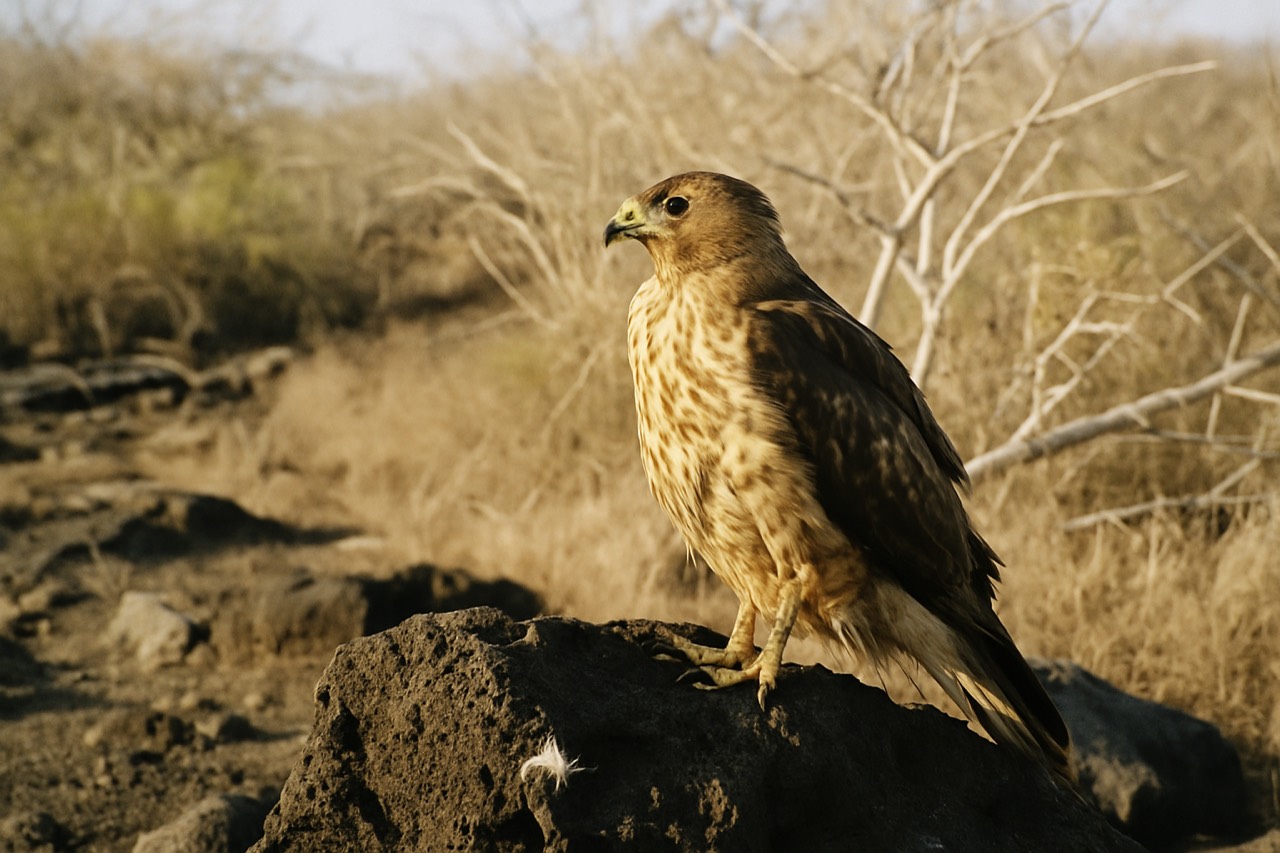
On land, the top predator in the Galapagos Islands is the Galapagos hawk, a dark, broad-winged raptor found nowhere else on earth. In the water, the archipelago belongs to sharks: scalloped hammerheads, Galapagos sharks and whitetip reef sharks patrol the marine reserve. What makes the islands genuinely unusual is not either of those animals, but the near absence of land predators altogether, which is exactly why the wildlife ignores you.
That last point deserves a moment, because it changes the whole experience of a trip. On most of the planet, wild animals flee at the first sight or smell of a human. In the Galapagos, sea lions flop over to inspect your snorkel fins, mockingbirds land on your daypack, and marine iguanas do not even twitch as you walk the marked trail past them. The reason is ecological, not habituation to tourists: the islands evolved for millions of years without any large land mammal hunting them, so the instinct to run from a biped simply never formed. The hawk, the owl and a couple of snake species are the full extent of the native land-hunting roster, and none of them ever needed to treat a human as a threat.
The sea tells a different story. The Galapagos Marine Reserve covers 133,000 km² and holds 2,909 identified marine species, 18.2% of them endemic, and its apex hunters are genuine heavyweights. Scalloped hammerhead schools gather in their hundreds around the northern islands of Darwin and Wolf, Galapagos sharks work the reefs, and orcas pass through in small family pods. For a package buyer the split matters in a practical way: land excursions are gentle and close-range, while the underwater half of the archipelago demands respect, a guide and a wetsuit.
If your interest in the wildlife is the reason you are comparing packages at all, this trio of tours is a reasonable starting point, each weighted toward a different style of wildlife access.
The Galapagos Hawk: The Ruler Of The Land
The Galapagos hawk (Buteo galapagoensis) is the only large land predator native to the islands, standing about 55 cm tall and hunting everything from young marine iguanas and lava lizards to centipedes and carrion. It is found across the inhabited and uninhabited islands, it is fearless around people, and the entire species exists nowhere else. Its only real rival on land is the short-eared owl, which hunts smaller prey at lower intensity.
The hawk is a genuinely odd raptor. Because the islands never had foxes, wild cats or birds of prey above it in the food chain, it evolved into a generalist that will take almost anything it can physically subdue: hatchling iguanas, land and marine iguana juveniles, sea turtle hatchlings emerging from nests, rats where rats have been introduced, and a great deal of carrion. It also practises cooperative polyandry, a rare breeding system in which one female mates with several males and all of the males help raise the chicks, a strategy researchers link to the unpredictable food supply of an ocean island.
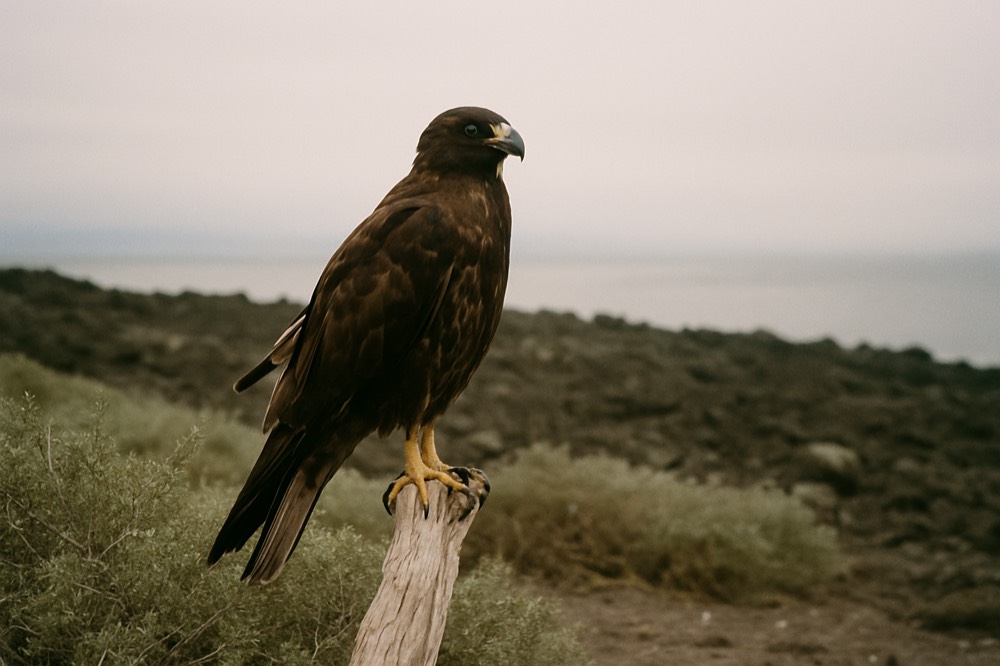
For visitors, the hawk is often the first predator you see, because it perches in the open near trails on Santa Cruz, Española and Isabela and rarely bothers to move. Its silhouette, broad wings and a short, fanned tail against the garúa haze, is one of the defining images of the highland zones. Under the visit rules in force since August 2026, you owe it two metres of distance like every other animal, and using bait or calls to draw it closer is prohibited outright.
The hawk's status is a conservation paradox worth knowing before you go. The species is listed as vulnerable, with the park estimating only a few hundred breeding pairs across the archipelago, yet on islands such as Española it is conspicuous and seemingly everywhere. The threat to it has never been a bigger predator, because there is not one. The threats are introduced animals competing for prey, historical persecution by settlers, and the slow pressure of a small population on small islands.
Sharks: The Real Apex Of The Archipelago
In the water the top predators of the Galapagos are sharks, above all the scalloped hammerhead, which schools in large numbers around Darwin and Wolf in the far north, plus the Galapagos shark, the whitetip reef shark and the blacktip shark. Orcas also pass through the reserve. Divers rank the northern islands among the finest shark sites on the planet, and the reserve's protection is what keeps those schools intact.
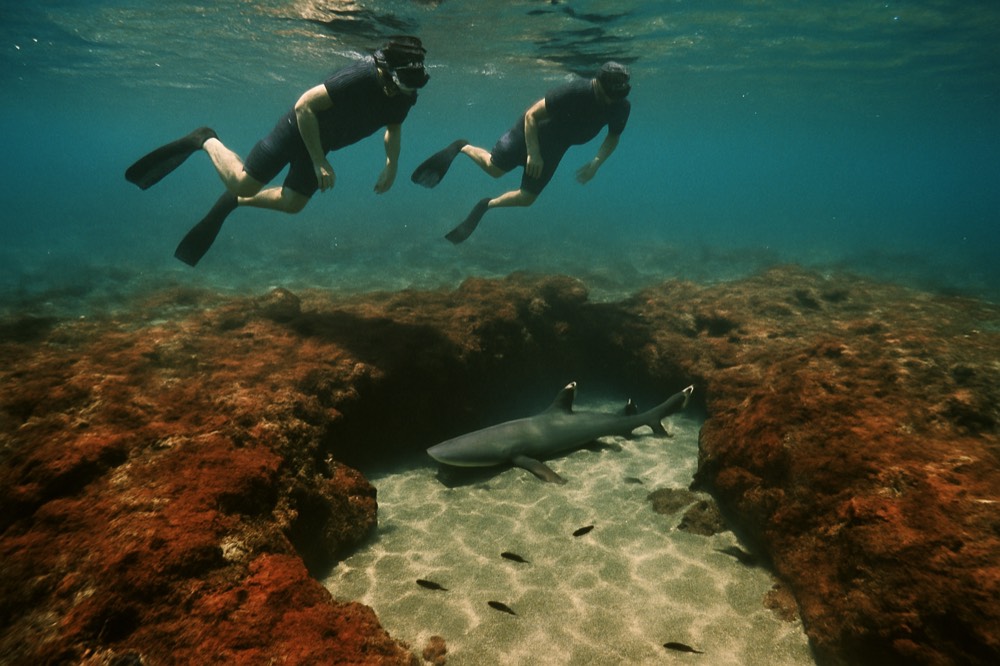
The hammerhead schools are the headline act. At Darwin and Wolf, two small islands reachable only by liveaboard, scalloped hammerheads gather in aggregations that divers describe in the hundreds, often with Galapagos sharks and the occasional whale shark in the same water column. Closer to the central islands, whitetip reef sharks rest in lava caves and crevices by day and hunt reef fish by night, and blacktips patrol the shallow mangrove bays where juvenile sharks grow up. The mangroves around Isabela and Santa Cruz function as shark nurseries, which is one reason the shallow, warm bays you snorkel on a standard package are so full of life.
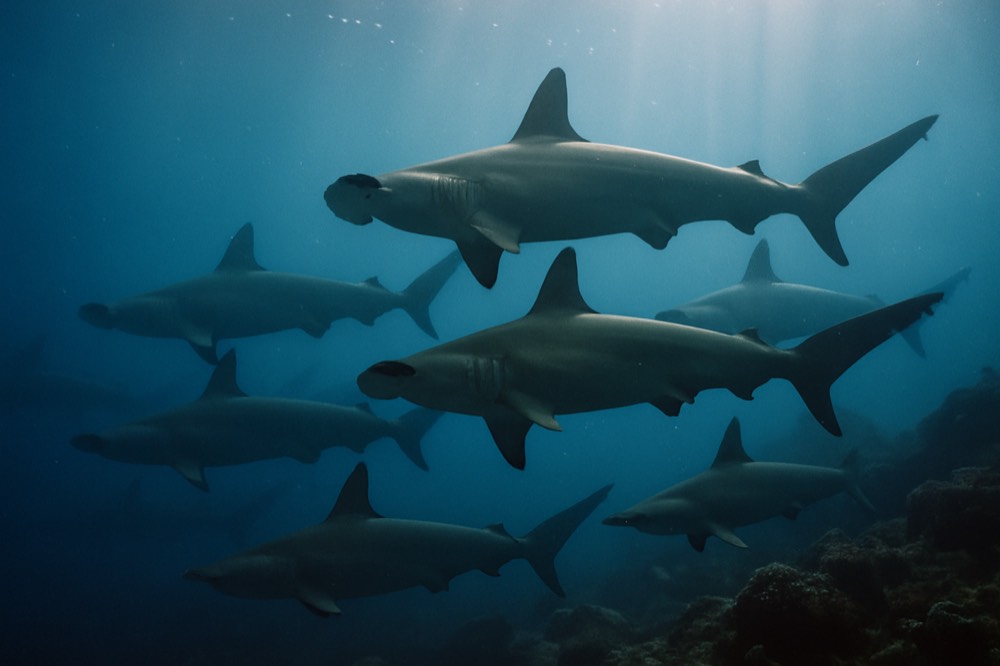
The park's monitoring gives a sense of scale. In 2025 the Galapagos National Park Directorate recorded 81 juvenile sharks in its marine monitoring counts, alongside 26,336 marine iguanas, 6,936 sea lions and 336 sea turtles, and the reserve's no-take zones are credited with keeping shark biomass high compared with fished waters elsewhere in the eastern Pacific. A 2024 census by the park and the Charles Darwin Foundation counted 413 Galapagos penguins and 762 flightless cormorants around Isabela and Fernandina, which tells you those predator-rich western waters are also the most productive in the archipelago.
You do not need to be a diver to see sharks. Day snorkels on Santa Cruz, San Cristobal and Isabela regularly pass over resting whitetips, and the penguin and cormorant waters of the western islands, reached on cruises that call at Fernandina and Isabela, are the best place in the archipelago to see predators and prey sharing the same bay. The rules of engagement are strict and worth learning before you swim: two metres minimum from any animal, four metres from the shore and from animals while kayaking or on panga rides, and 100 metres from whales, doubled when calves are present, with no more than 25 minutes watching a single group of cetaceans.
Why The Islands Have Almost No Land Predators
The Galapagos never connected to the mainland, so land mammals never colonised them: no big cats, no canids, no bears. The native land predator list runs to the hawk, the short-eared owl, a few snake species, herons and the endemic centipede, and that is essentially all. This predator vacuum is why the animals evolved without fear responses, and it is the single biggest reason the wildlife viewing here feels different from anywhere else.
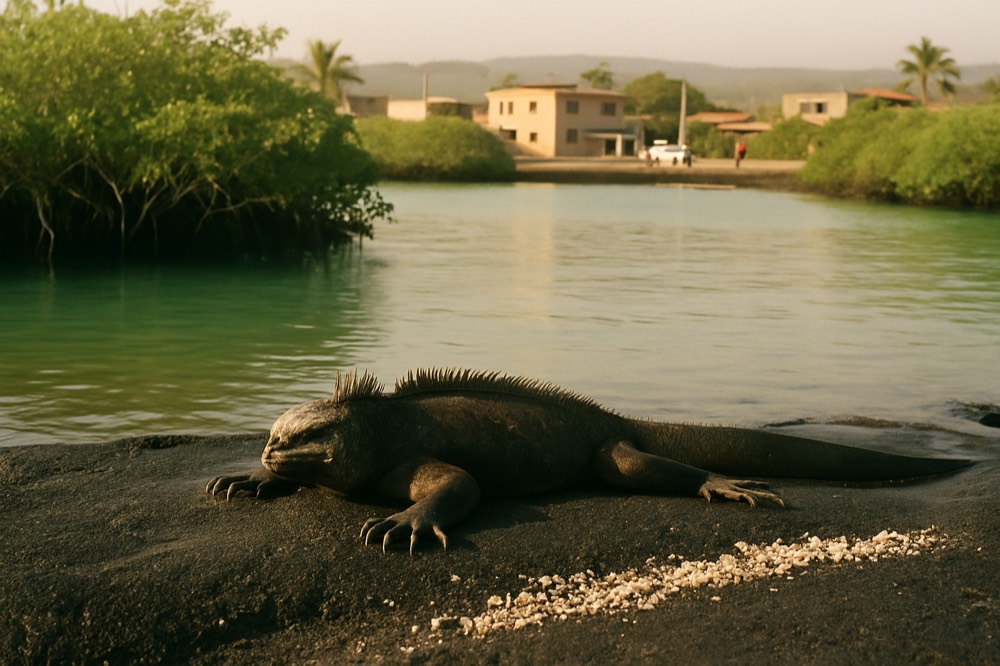
The archipelago sits about 1,000 km off the coast of South America, and every land animal that ever arrived had to survive a journey over open ocean. Reptiles, whose eggs and slow metabolisms tolerate salt water and long voyages, made it repeatedly: all 36 reptile species in the islands are endemic, including the world's only marine iguana. Small birds arrived on storms and evolved into the finches and mockingbirds. Large mammalian predators did not make it, full stop, and the ecosystem built itself around that absence. Giant tortoises grew to enormous size with nothing to fear, iguanas bask in the open, and seabirds nest directly on the ground in colonies that would be annihilated anywhere else.
| Habitat | Native top predator | Main prey | How often visitors see it |
|---|---|---|---|
| Land, all islands | Galapagos hawk | Juvenile iguanas, lizards, hatchlings, carrion | Common on highland and coastal trails |
| Land, night | Short-eared owl | Petrels, small birds, invertebrates | Occasional in lava fields and highlands |
| Shallow bays | Whitetip reef shark | Reef fish, octopus | Very common while snorkelling |
| Reefs and pinnacles | Galapagos shark, blacktip shark | Reef fish, rays | Common on dive and deep snorkel sites |
| Northern islands | Scalloped hammerhead schools | Fish, squid, rays | Liveaboard divers only, Darwin and Wolf |
| Open water | Orca pods | Fish, sea lions, turtles | Rare, mostly on crossings |
The absence of fear is not a trick or a habituation to tourism. It is the endpoint of millions of years in which nothing on four legs ever hunted a ground-nesting bird. Guides will tell you the animals have no predators to flee, and the honest version of that sentence is that they have almost none on land, while the sea side of the food chain is as sharp as any on earth. Both halves are worth planning around, and a package that mixes highland walks with water time shows you the contrast in a single day.
Introduced Predators: The Ones That Actually Cause Damage
The most damaging predators in the Galapagos today are not native at all: black rats, Norway rats, feral cats, dogs and pigs, brought by ships and settlers since the 1500s, have destroyed ground-nesting seabird colonies and tortoise hatchlings across the inhabited islands. Park eradication programs have removed goats and donkeys from several islands, and rats remain the hardest target, which is why biosecurity at the mainland airports is so strict.
This is the uncomfortable half of the predator story. The native hawk takes some hatchlings, but the introduced black rat eats its way through entire colonies of petrels and penguins, taking eggs and chicks at a rate no native predator ever evolved to counter. Feral cats on the inhabited islands hunt juvenile iguanas and birds. Dogs have killed tortoises on Santa Cruz. The park's response has been one of the most sustained eradication campaigns anywhere: goats and donkeys were removed from Isabela's northern volcanoes by 2006, which the park credits for the recovery of the Alcedo tortoise population, now estimated at 12,000 to 15,000 animals, the healthiest in the archipelago. Rat eradication on Pinzón allowed tortoise hatchlings to survive in the wild there for the first time in over a century, and the park now estimates 975 to 1,100 tortoises on that island.
Every traveller participates in this fight, usually without noticing. The biosecurity inspection at Quito or Guayaquil airport exists precisely because a single seed, fruit or animal product in your checked bag can carry an invasive species into one of the most fragile ecosystems on the planet, and the inspection is repeated at the inter-island docks before every ferry between inhabited ports. Pack accordingly, and check the official regulated-products list before you shop for snacks.
How Close Can You Get? The Rules Around Predators And Prey
Under the visit rules in force since 12 August 2026, you must stay two metres from any animal while walking, snorkelling or diving, camera gear included, and four metres from the shore while kayaking, on a paddleboard or in a panga. Whales get 100 metres, dolphins 50, doubled when calves are present, and you may watch one group of cetaceans for at most 25 minutes. Touching, feeding or chasing any animal is prohibited.
Those numbers come from Resolución MAE-PNG/DIR-2026-0044-RM, the park's general visit rules, and they are enforced by guides who can lose their licences over violations. The two-metre rule sounds generous until a sea lion pup swims directly at your mask, which happens constantly; the correct response is to back away gently, because the obligation to keep the distance is yours, not the animal's. The full text of the resolution also restricts sunscreens containing oxybenzone or octinoxate during water activities, bans flash photography, and limits general visiting hours in the protected areas to 06h00 to 18h00. A licensed naturalist guide must accompany visits to protected sites, with narrow exceptions at designated free-access areas.
| Situation | Minimum distance | Notes |
|---|---|---|
| Walking, snorkelling, diving | 2 m | Camera and filming equipment included in the measurement |
| Kayak, SUP, panga ride | 4 m | From the shore and from the animals |
| Whales | 100 m | Doubled when calves are present |
| Dolphins | 50 m | Doubled when calves are present |
| Watching one cetacean group | 25 minutes maximum | Approach must be rear-lateral and parallel |
A few sites now require an advance QR reservation through the park's system, including the Fausto Llerena tortoise breeding centre on Santa Cruz and the Arnaldo Tupiza centre on Isabela, and only agencies registered in Galapagos province can make those bookings. In practice that means a legitimate package operator holds the reservation for you, and a walk-up arrangement with an unregistered operator cannot get you in. It is one more reason booking through a structured package, rather than assembling day tours on arrival, has become the practical default.
Which Packages Put You Closest To The Action
For predator-watching on a land-based package, the 4-Day Wildlife Tour in Santa Cruz Island is the strongest fit on this site's roster, combining highlands tortoise territory, bay excursions and confirmed stops at North Seymour and South Plaza, with Bartolomé offered as one of several optional island choices, from $1561 per person with all meals included. For the marine side, the 7-Day Penguin Route tour reaches the western waters around Isabela where penguins, cormorants and reef sharks overlap, from $1857.
The wildlife tour on Santa Cruz rates 5 across 4 reviews, a small pool reported honestly, and its confirmed stop list reads like a predator-and-prey checklist: Bartolomé for penguins in the bay, North Seymour for frigatebirds and sea lions, South Plaza for land iguanas, and the Santa Cruz highlands for tortoises in the wild. Because it is full board with hotel pickup, the practical friction of getting between sites disappears, which matters when the good light for wildlife is early morning and late afternoon. You can read more about the four-day wildlife itinerary on Santa Cruz and Check availability on the live listing.
The Penguin Route tour, 5 across 3 reviews and from $1857 per person, is the land-based option that pushes furthest into the western predator territory, with confirmed stops at Bartolomé, Isabela, North Seymour and Pinzón. Its name is honest: the Galapagos penguin, the only penguin that lives and nests on the equator, concentrates around the cold, nutrient-rich upwelling along western Isabela and Fernandina, the same waters where the park counted its 391 penguins in 2025. Fewer than 400 individuals in the last two counts means every sighting is a genuine event, and this route is built around them. You can also review the seven-day penguin route itinerary in detail.
If the shark half of the story is what draws you, the cruise roster is where that question is answered properly, and our guide to Galapagos liveaboard packages covers the dive-focused options in detail. For a general sense of what the cruise format costs against a land-based week, the average cost of a Galapagos cruise breaks the numbers down by length and cabin class. The short version: land-based wildlife weeks run from roughly $1,000 to $3,000 per person before flights and fees, while cruises that reach the remote predator hotspots start higher and climb steeply.
Whatever you book, the practical advice from this site, Galapagos Islands Tour Packages, is to carry the entry fees in cash. The $200 park fee is collected in US dollars by rangers at Baltra or San Cristobal airport on arrival, with no online prepayment option, and the $20 transit control card is bought at the counter in Quito or Guayaquil before check-in. Both are extra on most packages, and neither accepts a card reliably.
Common Questions About The Top Predator In The Galapagos Islands
What Is The Top Predator In The Galapagos Islands?
The Galapagos hawk is the top land predator, and sharks, especially scalloped hammerheads, Galapagos sharks and whitetip reef sharks, are the apex predators of the surrounding marine reserve. On land the native predator list is otherwise remarkably short: a short-eared owl, a few snakes and herons complete it.
Are There Any Dangerous Animals In The Galapagos?
Not in the sense most travellers mean. There are no venomous snakes, no large mammalian predators and no animals that hunt humans. Sharks are present in large numbers but are not a threat to snorkellers under guided conditions, and the park's two-metre minimum distance rule keeps both you and the wildlife safe.
Why Are Galapagos Animals Not Afraid Of People?
The islands were never connected to the mainland, so large mammalian predators never colonised them. The native animals evolved for millions of years without anything hunting them from the land, so the flight instinct that wildlife shows elsewhere never developed here.
Do Galapagos Hawks Attack Other Birds?
Yes. The hawk takes juvenile iguanas, lizards, hatchling sea turtles and the eggs and chicks of smaller birds, and it scavenges carrion. It is a generalist opportunist, which suits an island food supply that swings with ocean conditions.
Can You See Sharks While Snorkelling On A Standard Package?
Regularly. Whitetip reef sharks rest in lava crevices on the standard snorkel sites around Santa Cruz, San Cristobal and Isabela, and blacktips patrol shallow mangrove bays. The big hammerhead schools around Darwin and Wolf are only reachable on liveaboard dive trips.
What Predators Were Introduced To The Galapagos?
Black and Norway rats, feral cats, dogs and pigs, all brought by ships and settlers. They have done far more damage to ground-nesting birds and tortoise hatchlings than any native predator, and the park runs ongoing eradication and biosecurity programs against them.